Aidan Frey
Create Your First Project
Start adding your projects to your portfolio. Click on "Manage Projects" to get started


Wurtzite Ferroelectric Testing - Senior Design
Project type
Non-Volatile Memory Research
Date
May 2026
Location
Golden, CO
Our project was centered around the ability of a wurtzite material to repeatedly polarize in environments of varying humidities and temperatures. We started with a furnace and most of the equipment necessary to electrically test the ferroelectric samples. This meant we had to figure out how to humidify the furnace to a constant desired humidity and build a probe station before we could even begin testing.
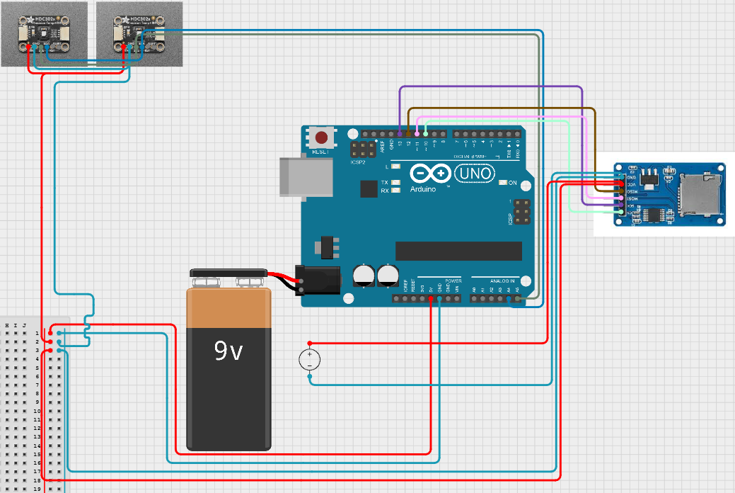
The solution we arrived at was to use a gas washing bottle to saturate flowing nitrogen with water before sending it into the furnace. To combat condensation in the tubing to the furnace, we built a NiCr heater. The final heater design took multiple attempts because the NiCr temperature was difficult to read, and hand-winding the wire created hot spots. With the help of an Arduino sensor setup and professional electrical engineering advice, we eventually got the heater working.
But there were still issues with the setup. Water condensed inside the inner furnace tubing, and the furnace struggled to regulate its own temperature. We rerouted the gas flow directly into the chamber and installed a new thermocouple that measured chamber air temperature. While this improved temperature sensing, it caused the PID system to oscillate the furnace by roughly 15-20℃. Being so near to the end of the project, we decided to leave the oscillations alone.
We shifted to testing in the probe station we designed. Due to the sample sensitivity and our limited experience, we killed a LOT of samples. Once we got one sample through calibration, we realized that the probe connections were not robust enough to survive being moved into the furnace. At that point, we determined the samples would need to be wire-bonded for proper testing.
Unfortunately, that was where our final semester ended. Even though we never completed the paper, we built a functioning humidity testing chamber for very cheap, learned how to design heaters and sensor systems, and gained experience with ferroelectrics and troubleshooting real engineering problems. And I certainly learned more than if we had simply been handed a HAST chamber and told to collect data.
Figures 1-2: Whole Setup
3: 3 Endurance Tests
4: Arduino Wiring Diagram
5: 3D printable Arduino Case
6: Machined Furnace front plate
7: Probe Stations